
Robert Burns (25 January 1759 – 21 July 1796) was a poet and a lyricist. He is widely regarded as the national poet of Scotland, and is acclaimed worldwide. Robert Burns was initiated into Lodge Saint David Tarbolton on 4 July 1781.
His work offered pride to a country whose crown, half a century earlier, had passed unrightfully from its unbroken Scottish Stewart dynasty to the Germanic Hanovers by way of English Parliamentary decree. His words gave solace to a people whose Highlands were being cleared for sheep, and whose families were forcibly split by a combination of English wars and economic hardship, many to flee home for opportunity abroad and never to see Scotland again. Whereas in the Tudor years and prior, Scotland could at least leverage her strategic location and support between the ceaseless intrigues and wars of England and France, she was by the early eighteenth century a harmless vassal to the north whose only use was manpower, sheep fodder and the occasional estate. Robert Burns, through verse, elevated the national pride of his downtrodden country and told the world of the Scottish tragedy. He also conveyed the culture and people in an endearing and lasting fashion leaving us with his beautiful imagery of life in the late eighteenth century.
There is a distinct line of Scottish progress marked by Burns’ popularity. Use the search engine of your preference (the most popular search engine is based on an algorithm, a mathematical concept divined by Scotsman John Napier) and enter 'inventions of the Scottish people'. You will find that an uncanny amount of the most important discoveries, advances and inventions of the nineteenth century were made by the Scottish. As you browse through the impressive list of Scotsmen, make note of their life dates and the dates of discovery for their respective invention, or find, and it will soon be apparent that most of them came after Robert Burns (1759 - 1786) by about eight to one.
Making cast steel from wrought iron: David Mushet (1772-1847)
Wrought iron sash bars for glass houses: John C. Loudon (1783-1865)
The hot blast oven: James Beaumont Neilson (1792-1865)
The steam hammer: James Nasmyth (1808-1890)
Wire rope: Robert Stirling Newall (1812-1889)
Steam engine improvements: William Mcnaught (1831-1881)
The Fairlie, a narrow gauge, double-bogey railway engine: Robert Francis Fairlie (1831-1885)
The mechanical reaping machine: Rev. Patrick Bell (1799-1869)
The Fresno Scraper: James Porteous (1848-1922)
Universal Standard Time: Sir Sandford Fleming (1827-1915)
Light signalling between ships: Admiral Philip H. Colomb (1831-1899)
The telephone:(disputed) Alexander Graham Bell (1847-1922)[4]
The teleprinter: Frederick G. Creed (1871-1957)
The television: John Logie Baird (1888-1946)[5]
Radar: Robert Watson-Watt (1892-1973)[8]
Fax Machine - Alexander Bain
Radio (underlying principles) - James Clerk Maxwell (1831-1879)
Identifying the nucleus in living cells: Robert Brown (1773-1858)
Hypnosis: James Braid (1795-1860)
Colloid chemistry: Thomas Graham (1805-1869)
The kelvin SI unit of temperature: William Thompson, Lord Kelvin (1824-1907)
Devising the diagramatic system of representing chemical bonds: Alexander Crum Brown (1838-1922)
Criminal fingerprinting: Henry Faulds (1843-1930)
The noble gases: Sir William Ramsay (1852-1916)
The Cloud chamber: Charles Thomson Rees Wilson (1869-1959)
Pioneering work on nutrition and poverty: John Boyd Orr (1880-1971)
The ultrasound scanner: Ian Donald (1910-1987)
...you get the point.
Did Burns' nationalistic poetry move and inspire a whole generation of his countrymen to establish one of the most important eras of invention the world has ever known? Or was it merely a coincidence? Perhaps he was simply among the first in a long line of innovators who came from the least obvious of places? There is no doubt that the astounding progress of the Scottish occurred for a number of reasons - not the least of which was the rebirth of national pride, the availability of education and the relative taming of religion. Perhaps it is best to impart that, in the eighteenth century, Prometheus spoke with a Scottish Brogue. He carried a torch comprised of wood from the felled trees of the Highland clearances. In lieu of a lost kingdom, a pitch soaked rag was crowned atop his torch and Robert Burns lit the match.
Burns started life in an anonymous, rustic Scottish village as the poor, blind traveler. He worked his way into everlasting light and ended his days as the master of his craft and was mourned by millions. There is no finer material exemplification of the symbolic Masonic course. Did he fall prey to the trappings of life in his travels? To be certain, don't we all?
Occasionally, as a Freemason, I have been subjected to the odd comment of "I don't think Robert Burns would have been admitted into a Masonic Lodge these days." The superfluous conjecture which circulates through some in the craft as to The Bard’s ability to make it through our petition process in modern Freemasonry without being "black balled" begs to be answered with a few questions: Would he want to sit in Lodge with you? Could you sit next to a "Robert Burns" without exhibiting profane jealousy or engaging in disgraceful backbiting? Never mind the built in, defensive piety of mediocrity. Are you enough of a Freemason that you would not hold a man's genius or accomplishment against him?
Beaux Pettys
January 25, 2009
MASONIC SONG
Robert Burns
 Ye sons of old Killie, assembled by Willie,
To follow the noble vocation;
Your thrifty old mother has scarce such another
To sit in that honoured station.
I′ve little to say, but only to pray,
As praying′s the ton of your fashion;
A prayer from the muse you well may excuse,
`Tis seldom her favorite passion.
Ye powers who preside o′er the wind and the tide,
Who marked each element′s border,
Who formed this frame with beneficent aim
Whose sovereign statute is order,
Within this dear mansion may wayward contention,
Or withered envy ne′er enter,
May secrecy round be the mystical bound
And brotherly love be the center.

THE MASTER′S APRON
Robert Burns
Ther′s mony a badge that′s unco braw;
Wi′ ribbon, lace and tape on;
Let kings an′ princes wear them a′
Gie me the Master′s apron!
The honest craftsman′s apron,
The jolly Freemason′s apron,
Be he at hame, or roam afar,
Before his touch fa′s bolt and bar,
The gates of fortune fly ajar,
`Gin he but wears the apron!
For wealth and honor, pride and power
Are crumbling stanes to base on;
Fraternity suld rule the hour,
And ilka worthy Mason!
Each Free Accepted Mason,
Each Ancient Crafted Mason.
Then, brithers, let a halesome sang
Arise your friendly ranks alang!
Guidwives and bairnies blithely sing
To the ancient badge wi′ the apron string
That is wom by the Master Mason

ADIEU, A HEART-WARM, FOND ADIEU
Robert Burns
Adieu, a heart warm, fond adieu,
Dear brothers of the mystic tie!
Ye favored, ye enlightened few,
Companions of my social joy!
Tho' I to foreign lands must hie,
Pursuing fortune's sliddery ba',--
With melting heart and brimful eye,
I'll mind you still, though far awa'.
Oft have I met your social band,
An' spent the cheerful, festive night;
Oft, honored with supreme command,
Presided o'er the sons of light;
And by that Hieroglyphic bright,
Which none but Craftsmen ever saw,
Strong memory on my heart shall write
Those happy scenes, when far awa'.
May freedom, harmony and love
Unite you in the grand design,
Beneath th' omniscient Eye above,
The glorious Architect divine;--
That you may keep the unerring line,
Still guided by the plummet's law,
Till order bright completely shine,
Shall be my prayer when far awa'.
And you farewell, whose merits claim
Justly that highest badge to wear,--
Heaven bless your honored, noble name,
To Masonry and Scotia dear!
A last request, permit me here;
When yearly ye assemble a',
One round,--I ask it with a tear
To him. the Bard. that's far awa'.BROKEN COLUMN: AGED 37 YEARS

Wha's like us? Damn few and they're A' died


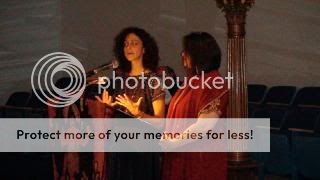 The presentation covered a number of different topics. The history of Hinduism in general was discussed at length, by Saivite Wilson, including origins and beliefs. Agni Ma led the crowd in and out of two meditations. She also spoke of Kashi Ashram's Yoga and Meditation programs which are a part of Kashi Ashrams interfaith outreach where Christians, Muslims, Jews and people of other faiths are taught to practice some of the many universal elements of the Hindu religion. Worshipful Master Bjelajac thanked Agni Ma and Saivite Wilson for their fine presentation and informed the gathering of our next month's event. After the presentation, our guests were treated to a tour of the Masonic Center and a peek at the library.




 Posts

